✓
No lock-in
✓
We handle the switch
✓
First month free

Tax Hero solves all of it
✓
Real-time numbers via Xero
See your profit, GST, and cash flow live
✓
Proactive tax planning all year
We find savings — you never ask first
✓
Fast support — 4–6 hour response
Real person, real answers, same day
How it works — Simple 3-step process
Switching accountants has never been easier. We handle the entire transition for you.
01
Book a Free Tax Review
15-minute call with one of our accountants. We review your current situation, identify tax savings, and give you a fixed-fee quote. Zero obligation.
02
We Switch You Over (48 hrs)
We contact your old accountant, collect your records, set up Xero, and take over. You don’t lift a finger. Most clients are live within 48 hours.
03
Pay Less Tax. Grow Faster.
From day one we’re proactively planning your tax, keeping your books accurate, and giving you the financial clarity to make confident business decisions.

Saved $18,400 for an Auckland tradie. Helped a consultant reduce tax by 32%. Recovered $11,700 for a landlord. Names changed for privacy.

Business Accounting

Rental Accounting

Sole Trader Accounting

Business Advisory

Company Formations

Cash Flow & Due Diligence











★★★★★
“Found $8,400 in savings in our first call”
— Marcus T., Auckland Builder
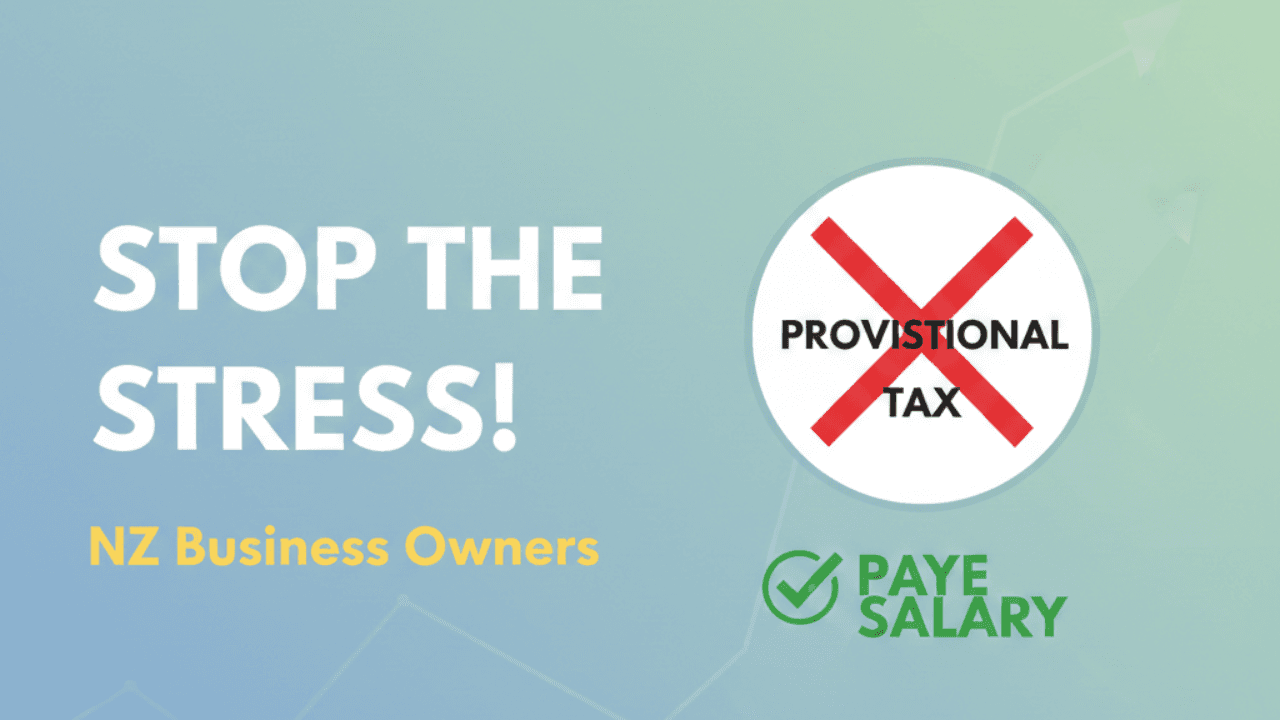
Stop the Stress: How NZ Business Owners Can Ditch Provisional Tax for Good
Tired of the cash flow roller coaster caused by provisional tax and surprise end-of-year tax bills? For many small business owners and company directors in New Zealand, the simple switch from "drawings" to a formal PAYE salary is the game-changer you've been looking for.
This method transforms your tax management from an annual headache into an easy, pay-as-you-go system.
The Provisional Tax Problem Solved
Provisional tax requires you to estimate and pre-pay your income tax throughout the year. If your income fluctuates, this can lead to overpaying, underpaying, or nasty interest charges.
The Solution? Put Yourself on a PAYE Salary!
When you take a formal salary, the exact amount of income tax (PAYE - Pay As You Earn) is calculated and deducted every pay cycle. Your company handles the tax payment to the IRD, just like for any other employee.
This means:
No more large lump-sum tax payments.
No more provisional tax liability.
No more major tax surprises at year-end.
Three Simple Steps to Switch to a PAYE Salary
Making the change is easier than you think, especially with modern payroll software.
Step 1: Choose Your Payroll Software
Sign up with a reliable online payroll provider. Popular New Zealand options, like iPayroll or Xero Payroll, integrate seamlessly and make the process incredibly simple.
Step 2: Calculate Your Gross Earnings
Work out the net amount you currently take as drawings (e.g., per week) and add the approximate tax you should be setting aside for it (e.g., an extra ). This total ($3,000) is your Gross Earnings.
Enter this Gross Earnings figure into your payroll software. The software will instantly calculate the precise PAYE amount required for the IRD.
Example (Weekly) | Amount |
Gross Earnings |
|
Less: PAYE (Tax) | (Approx.) |
Your Net Pay |
|
Export to Sheets
Step 3: Pay and Put Aside the PAYE
Pay yourself the Net Pay (the funds you actually receive).
Immediately transfer the calculated PAYE amount into a separate, dedicated bank account.
File and Pay: Your company is responsible for paying this PAYE amount to the IRD by the 20th of the following month. Since you set it aside weekly, the money is ready to go!
💰 Essential Tip: Pay Yourself the Full Profit
To completely avoid year-end shocks, ensure your gross salary is structured to cover the company's full net profit.
If your company's weekly profit (after all expenses except your salary) is , make sure your Gross Earnings in the payroll is also . If you are leaving profit in the company, ensure you have set that amount aside to cover the company's annual corporate tax liability (28%).
By consistently using a formal PAYE salary, you gain control, predictability, and best of all—you can finally say goodbye to the stress of provisional tax!
Read more →

Accounting Fees in New Zealand Explained: What You’re Really Paying For
Many business owners in New Zealand look at their accountant’s invoice and wonder, “Why are accounting fees so expensive?” It’s a fair question — and one that usually comes down to misunderstanding what actually goes into quality accounting work.
Behind accurate financial statements, correct tax filings, solid advice, and trustworthy support, there is time, skill, structure, and risk that most people never see.
This guide breaks down:
✔️ How accounting fees in NZ are calculated
✔️ The real time involved in preparing your accounts
✔️ The difference between junior and senior CA work
✔️ Why good accounting often saves you far more than it costs
Let’s demystify the numbers.
What Does a Chartered Accountant Cost in New Zealand?
While every firm charges differently, here are the realistic industry rates:
⏱ Junior Accountant / Intermediate Accountant:
$175 per hour
This covers tasks such as:
initial reconciliations
preparing working papers
drafting financial statements
GST returns
basic calculations
⏱ Chartered Accountant Senior Review / Advisory:
$300 per hour
This rate applies to:
reviewing financial statements
complex tax matters
strategic advice
IRD communication
high-risk decision making
⏱ Large National Firms:
Junior staff: $450+/hour
Partners: $600–$1,000+/hour
If you’re paying $1,200–$2,000 annually, you’re likely receiving mass-produced work — fast, cheap, and low value.
A decent accountant doesn’t operate like that.
Why Do Accounting Fees Seem High? The Skill & Responsibility Behind the Hourly Rate
Nearly a Decade of Training
A Chartered Accountant typically trains for around 10 years:
3–4 years Bachelor’s Degree
3 years CA professional qualification
3+ years hands-on advisory experience
That depth of training allows a CA to confidently advise you on financial, legal, and tax matters that have real consequences.
Managing Financial & Tax Risk
Accountants protect you from:
IRD penalties
incorrect GST filings
payroll errors
compliance breaches
cashflow danger
poor business structuring
A mistake can cost thousands. A good accountant reduces that risk dramatically.
Behind Every “Simple” Set of Accounts Is a Lot of Work
Even the most straightforward business requires substantial work to ensure accuracy, compliance, and risk-free reporting.
Where Do Your Accounting Fees Go? Full Breakdown (Updated With $175 Junior Rate)
Let’s break down a standard single-entity annual accounting job.
Annual Accounting Workflow
Task | Who Does It | Time | Cost |
Collect checklist info, review documents | Junior Accountant | 1 hour | $175 |
Prepare financial statements & full reconciliations | Junior Accountant | 4–8 hours | $700 – $1,400 |
Identify issues, query discussion with client | CA + Junior | 2 hours | $175 + $300 = $475 |
Prepare tax returns, resolutions & annual documents | Junior + CA | 2 hours | $175 + $300 = $475 |
Final review and sign-off meeting | Chartered Accountant | 2 hours | $600 |
Total Estimated Time:
10–15 hours
Total Estimated Cost:
$2,425 – $3,125 (for basic compliance)
This excludes:
year-round advice
IRD discussions
structuring
forecasting
cashflow support
GST Compliance:
Add 4–6 hours per year
Cost: $700 – $1,050
“Can I Do It Myself?” – Why DIY Accounting Is a Trap
Technically, yes — you can do your own accounting.
But here’s the reality:
A junior accountant takes 10–15 hours
A business owner will take 30–40 hours
AND likely get key things wrong
Example:
If you miscalculate provisional tax on $100k income, you could face:
$1,250 late payment penalty
$2,500 interest charges
A $3,750 mistake — all because of one incorrect assumption.
DIY accounting is slow, stressful, and often expensive in the long run.
Advisory Accounting: The Premium Level Most Businesses Should Have
If you want more than just “lodged tax returns,” you’ll want strategic support.
A CA-led advisory package usually includes:
2–3 strategy meetings
proactive tax planning
business performance insights
budgeting & forecasting
structure reviews
risk management
unlimited queries
Expected additional cost:
$1,000–$2,000 per year
This is where businesses usually see the highest return on investment.
So, What Should a NZ Business Budget for Accounting Each Year?
A reasonable annual budget for quality accounting is:
💰 $3,000 – $7,000 per year
This includes:
annual financial statements
income tax returns
GST returns
CA review
advisory touchpoints throughout the year
For most NZ small–medium businesses, this is the true cost of accuracy, compliance, and peace of mind.
The Hidden Value of a Good Accountant
A quality accountant:
Saves you time
Reduces tax
Prevents IRD penalties
Improves profitability
Guides major financial decisions
Helps during cashflow problems
Supports growth and strategy
Reduces stress and uncertainty
When a Chartered Accountant truly understands your business, the relationship becomes one of your greatest assets.
Conclusion: Accounting Fees Are Not an Expense — They’re an Investment
Quality accounting protects your business, your wealth, and your peace of mind.
When you consider:
the training
the time
the expertise
the risk
and the value of the advice
…it becomes clear that accounting fees are not just a cost — they’re a return-generating investment in your business's financial health.
Read more →

Budget 2025: What the New Tax Measures Mean for You and Your Business
Budget 2025 introduces a series of significant tax updates that will affect businesses, families, and KiwiSaver members across New Zealand. Below is a clear, easy-to-follow breakdown of the major changes — including the new Investment Boost, updates to KiwiSaver, and adjustments to Working for Families and the Best Start tax credit.
Investment Boost: Extra Support for Business Investment
A major highlight of this year’s Budget is the introduction of the Investment Boost, designed to encourage New Zealand businesses to invest in new assets.
How it works
From 22 May 2025, businesses purchasing qualifying new or new-to-New Zealand assets can claim an additional 20% tax deduction in the year the asset becomes available for use. This comes on top of normal depreciation.
What assets qualify?
Most depreciable business assets, including:
Machinery and equipment
Work vehicles
Newly built commercial or industrial buildings
Certain land improvements and sector-specific assets
Some assets won’t qualify — for example, residential buildings, second-hand goods bought within New Zealand, and many intangible assets.
Why it matters
Because the deduction is taken upfront, businesses benefit from a lower tax bill in the year of purchase, giving a welcome cash-flow lift. Claiming the deduction is straightforward — your accountant will include it in your tax return for the relevant year as long as proper records are kept.
KiwiSaver: Major Changes to Contributions and Eligibility
KiwiSaver sees some of the most wide-reaching updates in Budget 2025. These changes will affect employee contributions, employer contributions, government top-ups, and eligibility for younger members.
Employee & Employer Contributions Increasing
Default contribution rates will gradually rise:
3.5% from 1 April 2026
4% from 1 April 2028
Employees who find the increase difficult can temporarily apply for a reduced rate.
Government Contribution Reduced
From 1 July 2025:
The government match reduces from 50c to 25c per dollar contributed.
The maximum annual government top-up falls from $521.43 to $260.72.
Individuals earning over $180,000 per year will no longer receive the government contribution.
These changes do not affect contributions for the current KiwiSaver year — those will still be paid under the existing rules.
16–17 Year Olds Included
Government contributions start for 16–17 year olds from 1 July 2025.
Employer contributions begin from 1 April 2026.
Working for Families & Best Start: Updated Thresholds and Targeting
Significant adjustments are also coming to family tax credits.
Working for Families
Starting 1 April 2026:
The abatement threshold increases from $42,700 to $44,900.
The abatement rate increases from 27% to 27.5%.
This shift is intended to better align support with household income levels while maintaining Budget balance.
Best Start Tax Credit
Also from 1 April 2026:
The first year of the Best Start payment becomes income-tested, consistent with the existing rules for years two and three.
This applies to children born on or after 1 April 2026.
Families will need to provide income information at the time of application starting in the 2026/27 year.
Read more →

© 2026 TaxHero Accountants. All rights reserved.